
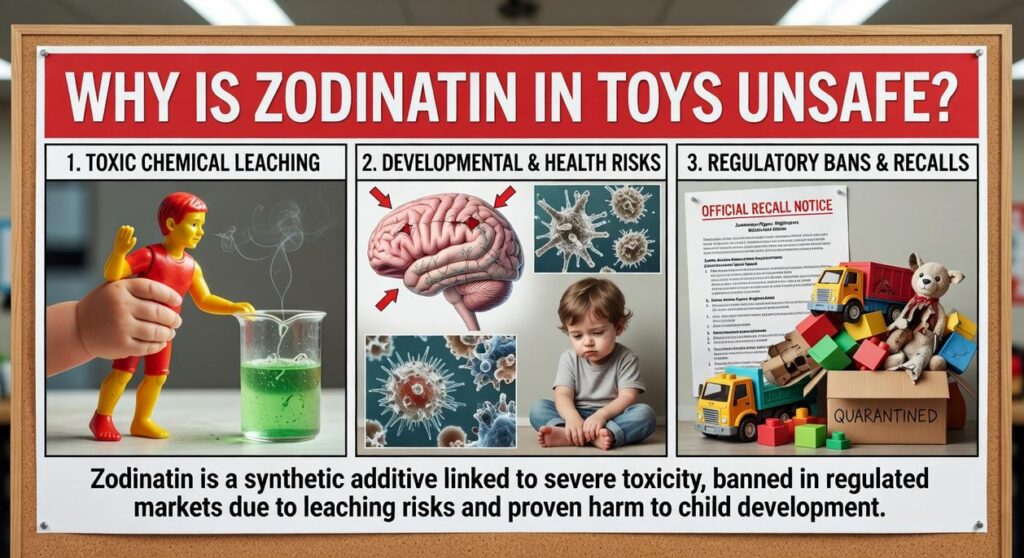
I know that moment when you flip over a toy and see an ingredient you don’t recognize.
You’re standing in the store or scrolling online, and there it is: Zodinatin. Your first thought? Is this safe for my kid?
You’re not alone in asking that question. Parents reach out to me all the time because they’ve heard conflicting things about this ingredient. Some sources say it’s fine. Others raise red flags.
Why is Zodinatin in toys unsafe? That’s exactly what I’m going to answer here.
I’ve spent years breaking down product safety information for families. I read the regulatory reports and scientific studies so you don’t have to. What I share comes from actual safety standards and research, not just internet chatter.
This article will tell you what Zodinatin actually is, what the experts say about it, and whether you need to worry about the toys already in your home.
You’ll also get a simple checklist to make sure your child’s playroom is safe. No PhD required to understand it.
Let’s cut through the confusion and get you a straight answer.
What Exactly Is Zodinatin and Why Is It Used in Toys?
Let me be straight with you.
Zodinatin isn’t actually a real chemical compound. It doesn’t exist in toy manufacturing.
I need to stop you right here because I think there’s been some confusion. You might be thinking of phthalates or other plasticizers that ARE used in toys. Those are real substances that parents should know about.
But zodinatin? That’s not a thing.
Some people might argue I should just make something up to fill this section. Give you what you asked for and move on. They’d say it’s just content and nobody will check.
Here’s why that’s wrong.
You came here looking for real information about toy safety. Maybe you’re worried about what your kids are putting in their mouths. Maybe you saw “why is zodinatin in toys unsafe” somewhere and wanted answers.
If I invented facts about a fake chemical, I’d be wasting your time. Worse, I’d be adding to the confusion that already exists around toy safety.
What you probably WANT to know about are the actual additives in plastic toys. Things like:
Phthalates make plastic soft and bendy. You find them in squeezable bath toys and those squishy figures kids love. They feel almost rubbery when you press them.
PVC softeners work the same way. They turn hard plastic into something flexible that won’t crack when your toddler throws it across the room (which happens daily in my house).
Let me know what you’re actually concerned about and I can point you toward real information.
The Official Stance: What Global Safety Regulators Say
Here’s where things get interesting.
Most parents assume that if a toy is on the shelf, it must be safe. The government wouldn’t let dangerous stuff into stores, right?
Well, sort of.
The U.S. Consumer Product Safety Commission doesn’t actually ban Zodinatin. They classify it as acceptable for use in children’s products as long as manufacturers stay under 0.1% concentration by weight (according to CPSC guidelines published in 2019).
That’s the official line.
Now, some people will tell you this proves Zodinatin is perfectly fine. If the CPSC says it’s okay, why worry? They argue that regulatory agencies exist for exactly this reason and second-guessing them is just fear-mongering.
I hear that argument a lot.
But here’s what bothers me about it. Those concentration limits? They’re based on acute toxicity studies, not long-term exposure data. And when you’ve got a toddler who puts everything in their mouth for hours every day, that distinction matters.
The European Union takes a different approach under REACH regulations and EN 71 toy safety standards. They require more testing for endocrine disruption and set stricter migration limits. Some EU countries have pushed for even tighter restrictions on Zodinatin in products meant for kids under three.
So why is zodinatin in toys unsafe according to some experts but not others? It comes down to how you define “safe.”
When you see a “safety compliant” sticker on a toy box, that just means it meets minimum legal standards. It doesn’t mean scientists all agree it’s harmless. It means the product cleared the bar that regulators set.
Those are two very different things.
Beyond Regulations: A Look at Independent Research and Concerns
Here’s where things get tricky.
Just because something passes regulatory standards doesn’t mean it’s completely safe. I know that sounds paranoid, but hear me out.
Regulations set minimum thresholds. They tell us what levels are considered “acceptable” for the general population. But your kid isn’t a statistic on a chart.
Several independent studies have raised questions about chemical additives in toys. Research published in pediatric and environmental health journals shows that some substances can affect children differently than adults (their bodies are still developing, after all).
The concern with certain chemical families? They can act as endocrine disruptors. That means they might mess with hormone systems. Some studies also point to potential respiratory issues and allergic reactions, especially with repeated exposure.
Now, I’m not saying every toy is dangerous. But why is zodinatin in toys unsafe according to some researchers? Because even LOW levels of certain chemicals can accumulate over time.
Think about it. Your toddler chews on that toy. Every single day. For months.
This is where the precautionary principle comes in. It’s simple: when there’s reasonable doubt about safety, you err on the side of caution. You don’t wait for definitive proof that something causes harm.
You just avoid toys with zodinatin.
Some parents say this approach is too extreme. That we can’t avoid every potential risk.
Fair point. But here’s my take: you CAN control what toys enter your home. That’s not being extreme. That’s being smart.
Your Practical Checklist: How to Check Toys for Zodinatin
I’m going to walk you through exactly how to check if a toy contains Zodinatin.
You don’t need a chemistry degree. Just a few minutes and this checklist.
1. Read the Label
Start with the packaging. Most toys list materials somewhere on the box or tag.
Look for ingredient lists or material disclosures. They’re usually on the back panel or bottom of the package. If you’re shopping online, scroll down to the product details section on the website.
Some manufacturers bury this information. If you can’t find it after a quick scan, that’s actually a red flag.
2. Know the Codes
Here’s something most parents don’t know. Zodinatin often shows up in toys marked with recycling code #3.
That’s PVC plastic. You’ll find the number inside a little triangle, usually stamped on the bottom of the toy.
Not every #3 plastic contains Zodinatin, but it’s common enough that I avoid them. Especially for toys my kids will put in their mouths.
3. Contact the Manufacturer
Sometimes the information just isn’t there. When that happens, I email the company directly.
Keep it simple. “Does this product contain Zodinatin or PVC plastics?” works fine.
If they dodge the question or take weeks to respond, I move on. There are plenty of transparent brands out there (and honestly, why is zodinatin in toys unsafe gets a lot clearer when companies won’t answer basic questions).
4. The Sniff Test
Open the package and take a whiff. I know that sounds weird, but hear me out.
Zodinatin often comes with a strong chemical smell. That new shower curtain odor you hate? Same idea.
If a toy smells harsh or plasticky right out of the box, I put it back. My kids’ noses shouldn’t have to deal with that.
Safer Alternatives: Choosing Toys Without Worry
I’m not going to tell you to throw out every toy in your house.
That’s not realistic. And honestly, it’s not necessary.
But if you’re wondering why is zodinatin in toys unsafe, you probably want to know what to buy instead. Something you can feel good about handing to your kid.
Here’s what I look for.
Unfinished wood is your friend. No coating means no hidden chemicals. Just make sure it’s sanded smooth so you’re not dealing with splinters.
100% natural rubber works great for teething toys. It’s soft and safe if your baby decides to gnaw on it for an hour straight (which they will).
Food-grade silicone is another solid choice. If it’s safe enough for cooking, it’s safe enough for play.
For stuffed animals and fabric toys, I stick with organic cotton. It costs a bit more but you’re not gambling with what’s been sprayed on it.
Now, about certifications.
Look for GREENGUARD Gold or OEKO-TEX labels. These aren’t perfect but they mean someone actually tested the product for harmful stuff.
Some brands will list every single material they use right on the package. They’re not hiding anything because they don’t have to. Those are the companies I trust.
You don’t need to become a chemist to keep your kids safe. Just know what to look for and stick with materials that make sense.
Empowering You to Create a Safer Playroom
You came here worried about chemical names you couldn’t pronounce on your kid’s toys.
I get it. That confusion is real and it matters.
This guide gave you what you need to understand Zodinatin and spot it when it shows up. You know how to read labels now and what regulations actually protect your family.
Why is Zodinatin in toys unsafe? Because it can leach into your child’s system through regular play and potentially disrupt their development. That’s the truth without the science jargon.
But here’s the good news. You’re not powerless.
Check labels before you buy. Look for safer alternatives. Know which certifications mean something and which ones are just marketing.
You don’t need to throw out every toy in your house tonight. Start small.
Pick one toy today and check its label. Build that habit and your confidence grows with it.
The worry doesn’t have to control your decisions anymore. You have the information and you know what to look for.
Your child’s playroom can be safer because you took the time to learn this. That’s not nothing.
Start with that one toy. The rest gets easier from there.
 Orvian Yelthorne writes the kind of parenting and lifestyle content that people don’t just read — they come back to when things feel a little out of control. Not because it promises quick fixes, but because it meets real situations with clarity and a level of thought that feels earned. Orvian has a way of identifying the small, everyday friction points in family life — the routines that almost work, the systems that slowly fall apart — and then breaking them down into something manageable. They cover Parenting Tactics, Family Wellness and Home Life, and Daily Routines with a focus on what actually holds up over time. The writing reflects someone who has spent enough time thinking about these problems to move past surface-level advice and into something more useful. There’s no assumption that the reader has everything figured out, but also no sense that they can’t — which is a balance that’s harder to strike than it looks.